Is Anybody In There? An Introduction to Artificial Intelligence for Everyone
In 1770 a machine beat people at chess with a man inside it. Where AI comes from, how it learns and why it gets things wrong, without jargon.
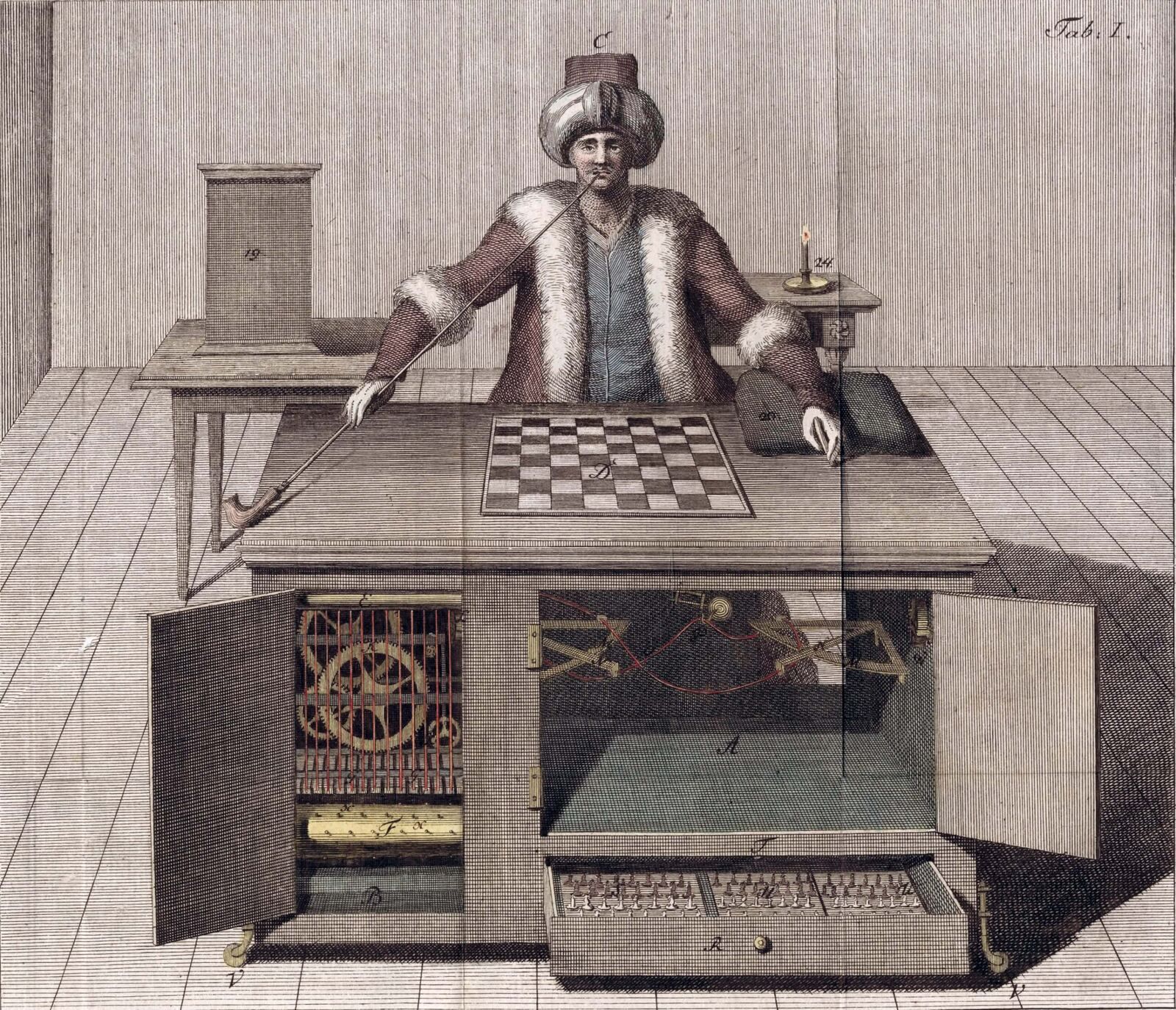
Vienna, 1770. In the palace of Schönbrunn, in front of Empress Maria Theresa, a court official called Wolfgang von Kempelen opens the doors of a wooden cabinet. Inside you can see wheels, gears, levers. Sitting behind the cabinet is a life-size figure dressed as a Turk, with a turban and a long pipe in his hand, looking at a chessboard. Kempelen closes the doors, winds up the mechanism with a key and the figure starts to move the pieces.
And wins.
It will go on winning for decades, under different owners, across half of Europe and America. According to the chronicles, Napoleon and Benjamin Franklin sat down to play it. And all that time there was a man inside: a good chess player, tucked into a sliding seat that hid him whenever the doors were opened, who followed the moves thanks to some magnets under the board and moved the figure’s arm with a system of levers.
The astonishing thing about the Turk is not the trick. It is how many people preferred to believe it.
More than two hundred and fifty years later you type a question to ChatGPT, it answers in impeccable Spanish, and the doubt is the same as in Schönbrunn: is there anybody in there? This article is the long answer. The short one, so you are not left in suspense: there is no gentleman hidden away. There are a great many more.
It is written for two people. For the one who nods when they say “ask the AI”, like someone who has it all under control, even though inside they have no idea what is behind it. And for the one who, in every family, used to set the video recorder, fixes the printer and receives from their aunt a four-minute WhatsApp voice note begging for help with the laptop. The first will leave here understanding. The second, able to explain it.
Almost three thousand years trying to make somebody
Since the end of 2022 it seems that artificial intelligence is ChatGPT. It is and it isn’t. ChatGPT is the tool that made it popular overnight, and the one that turned the know-it-all uncles of the world into experts in something they did not understand but thought they did. The idea of making a mind, on the other hand, is as old as myths. Let me tell you how we got here. The timeline is mine, and like every timeline it is arbitrary: others would pick other moments.
- 8th century BC
Hephaestus’s maidservants
In the Iliad, Homer tells that Hephaestus, the blacksmith god, had made himself golden maidservants who moved and spoke by themselves. The idea is older than the technique.
- 4th century BC
The syllogism
Aristotle describes the syllogism, which centuries later the textbooks would sum up like this: “All men are mortal; Socrates is a man; therefore Socrates is mortal”. For the first time, whether an argument is valid depends on its form, not on what it says.
- 1st century
Hero’s theatres
Hero of Alexandria describes in his treatise Automata mechanical theatres driven by weights, cords and falling sand: the movements are written down before they happen, a very ancient way of programming.
Al-Jazari’s contraptions
The engineer Al-Jazari finishes his Book of Knowledge of Ingenious Mechanical Devices, with fifty machines; among them, a boat with four automaton musicians that entertained the guests at palace parties.
- Around 1305
Llull’s wheels
Ramon Llull, from Majorca, designs some concentric wheels with concepts written on them that, as they turn, combine ideas: an attempt to mechanise reasoning.
- 1673-1694
Leibniz’s calculator
Leibniz builds a mechanical calculator and dreams of a language in which arguments are settled by doing sums. His motto: Calculemus!, “let us calculate!”.
- 1738-1739
Vaucanson’s duck
Jacques de Vaucanson presents in Paris a flute player who plays twelve melodies and, the following year, his duck: it flaps its wings, eats grain, “digests” it and expels it. The digestion was a trick: what came out of the back had already been prepared inside.
- 1768-1774
“The Writer”
Pierre Jaquet-Droz builds “The Writer”, an automaton boy who dips his pen and writes any text of up to forty characters, chosen on a wheel: a machine that can be programmed. It still works, in Neuchâtel (Switzerland).
The Turk
Kempelen’s Turk, with its hidden player. More than two centuries later, Amazon named a service Mechanical Turk in which people do, on commission, tasks that look as if a machine had done them. The joke was no accident. Keep it in mind, because it comes back.
The first program
Ada Lovelace publishes her notes on Babbage’s analytical engine, with what is today considered the first program, and a warning: the machine “has no pretensions whatever to originate anything”. Turing will call it “Lady Lovelace’s Objection”.
The laws of thought
George Boole shows in The Laws of Thought that reasoning can be written as algebra, with true and false in place of numbers.
- 1888-1906
Cajal’s neurons
Santiago Ramón y Cajal, looking through the microscope and drawing what he saw, shows that the brain is a set of independent cells that communicate with each other: neurons. Nobel Prize in Medicine in 1906.
Logic with wires
Claude Shannon proves in his master’s thesis that circuits with switches can do that algebra. Logic can now be built with wires.
The neuron as a switch
Warren McCulloch and Walter Pitts describe a neuron as a logical switch that turns on or not depending on what it receives: the brain, seen as a Boolean machine.
- 1946-1953
The Macy conferences
The Macy conferences sit mathematicians, neurologists, anthropologists and psychologists down together in New York to talk about the same thing in different words.
Cybernetics
Norbert Wiener publishes Cybernetics, with a central idea, feedback: a system that measures what it does and corrects itself, like a thermostat or like your hand when it reaches for a glass.
- 1948-1949
Grey Walter’s tortoises
William Grey Walter builds in Bristol two robot tortoises, Elmer and Elsie, that seek the light, dodge obstacles and go back to recharge by themselves. With next to nothing, they seem to have a will of their own.
Hebb’s rule
Donald Hebb proposes a simple rule: when two neurons fire at the same time, the connection between them is strengthened. It is the precise version, neuron by neuron, of an old idea about how a brain learns, and the one that neural networks will inherit.
The Turing test
Alan Turing publishes “Computing Machinery and Intelligence”. Instead of arguing about whether a machine “thinks”, he proposes a game: if in writing you cannot tell it from a person, what does it matter? It is the Turing test, the question of Schönbrunn turned into a method. And he suggests not programming an adult mind, but a “child machine” that can be educated.
Dartmouth names AI
A group of researchers meets at Dartmouth College to found a discipline, artificial intelligence, a name John McCarthy had proposed the year before in the call for the meeting. There Newell and Simon show the Logic Theorist, written with Cliff Shaw: a program that proves theorems by itself.
- 1957-1958
The perceptron
Frank Rosenblatt simulates on an IBM 704 the perceptron, the first artificial neuron that learns from examples. The New York Times reports that the Navy expects from it “the embryo of a computer able to walk, talk, see, write, reproduce itself and be conscious of its existence”.
A machine that learns to play
Arthur Samuel publishes a program that learns to play draughts by playing against itself. The title of his paper popularises the expression machine learning.
Networks in doubt
Minsky and Papert show in Perceptrons that those single-layer networks cannot learn some very basic things. The money for neural networks goes elsewhere.
- 1974-1980
The first winter
The Lighthill report (United Kingdom, 1973) and the cuts in the United States leave the whole of AI without money: the first “AI winter” arrives.
Backpropagation
Rumelhart, Hinton and Williams popularise backpropagation, a way of correcting networks of many layers by sharing out each error among the connections that caused it. It is the thaw.
AlexNet
AlexNet wins an image-recognition contest by a landslide with many layers, more than a million photos and video-game graphics cards doing the sums. A name takes hold: deep learning.
The transformer
A Google team presents the transformer, a way for the machine to learn which words matter for understanding each of the others. It is the T in GPT.
- 30 November 2022
ChatGPT
OpenAI opens ChatGPT to the public. The technique, which already existed, does not change: what changes is that anyone can talk to it from the browser.
- 8 October 2024
The Nobel for neural networks
The Royal Swedish Academy of Sciences awards the Nobel Prize in Physics to John Hopfield and Geoffrey Hinton for making machine learning with neural networks possible. More than eighty years after McCulloch and Pitts.
Four attempts cross in that line: imitating the body, imitating reasoning, imitating the brain and, finally, letting the machine learn by itself. The automata left machines that seemed alive and, above all, people ready to believe that they were. Logic left the conviction that thinking is following rules and that it would be enough to write them all down: it worked for chess, not for recognising a cat. And neuroscience left the two pieces that are inside ChatGPT: the neuron as a building block and learning as the adjustment of connections.
What we call AI today is, almost always, the fourth attempt: machines that learn from examples. So let us open the cabinet.
What is inside the cabinet
Artificial intelligence is an enormous name for something that today, in practice, almost always means the same thing: programs that, instead of following instructions written by a person, have learned from examples. That is machine learning.
Try it. Try to explain to someone, step by step and without mistakes, how to recognise a cat in a photo. Pointed ears? There are cats with floppy ears. Whiskers? Dogs have them too. Nobody knows how to write those instructions. So it is done the other way round: the machine is shown millions of photos, some with a cat and some without, and it is left to adjust its own insides until it gets it right.
Those insides are a neural network: a huge number of switches connected to one another that imitate, from very far away, Cajal’s neurons. What is adjusted is the strength of each connection, and those adjustments are called weights or parameters. The biggest models have trillions: millions of millions. They are the cabinet’s gears, only nobody has placed them by hand.
The model, a recipe nobody can read
When the training ends, what is left is called a model. Think of a recipe the machine has written by itself after trying millions of dishes: it works, but nobody, not even those who trained it, can read it line by line. A company trains the model once, over months and spending a fortune on electricity, and then it is used millions of times a day.
If the model has been trained on text (books, newspapers, websites, forums, code) and is very large, it is called an LLM, from the English large language model. ChatGPT, Claude and Gemini are LLMs with a chat window in front.
A machine for guessing what comes next
What an LLM has learned to do is a single thing: given a text, guess what comes next. Like the keyboard on your phone, which when you type “good” suggests “morning”, but having read an entire library and looking at the whole conversation, not just the last word. It guesses a piece, adds it and guesses again. That way, piece by piece, a paragraph comes out.
Notice that I say “piece”. The model does not read words: it reads tokens, pieces of text that are sometimes a whole word, sometimes half of one and sometimes a punctuation mark. “Hola” is usually one token; “inteligencia” can be two or three. In English, a token comes to about three quarters of a word; in Spanish, somewhat less, because these systems were trained mostly on English texts and chop up other languages less well.
It looks like an engineer’s curiosity, but it explains three things you are going to notice. That companies charge by tokens, not by sentences. That each model can hold only a limited number of tokens in its head at once, and that is why in very long conversations it forgets the beginning. And that a machine that writes so well struggles to count the letters in a word or to write it backwards.
It does not see letters. It sees pieces.
So, who is inside?
Now I can answer the question from Schönbrunn. Inside the model nobody is sitting. But what it has learned, it has learned from everything we people have written: millions of books, articles, forums, recipes and arguments. And before opening it to the public, OpenAI turned to people who wrote sample conversations and scored which answers were better, to teach it manners. When ChatGPT answers you, it is not a hidden gentleman speaking to you. It is an average of a great many people.
That explains the good and, as we are going to see, also the bad.
The race of recent years
There is no need to memorise names. It is enough to see the pace:
- 11 June 2018
The first experiment: a transformer trained only to guess the next word learns something about language along the way.
OpenAI
- 2 November 2018
It is not a chat: it is a model for understanding text, which Google publishes openly and the following year builds into its search engine.
Google
- 14 February 2019
It wrote texts so believable that OpenAI took months to release it in full, for fear of fake news.
OpenAI
- 28 May 2020
More than a hundred times bigger than the previous one: with a couple of examples it learns new tasks. From size alone.
OpenAI
- 30 November 2022
GPT-3.5 with a chat window and manners. In five days it has a million users: it is the day all this reaches your family.
OpenAI
- 24 February 2023
Meta shares it with researchers, its weights end up circulating on the internet and open AI takes off.
Meta
- 14 March 2023
It understands images and, in a simulation, passes the United States bar exam.
OpenAI
- 14 March 2023
The same day, Anthropic’s assistant is born, a company founded to make AI safer.
Anthropic
- 11 May 2023
Claude, a hundred thousand tokens
Its memory reaches a hundred thousand tokens, about 75,000 words: for the first time you can paste in a whole book and ask about it.
Anthropic
- 18 July 2023
Free even for commercial use: any company can set up its own assistant without paying licences.
Meta
- 6 December 2023
It is born understanding text, image, audio and video at once. In February 2024, Bard, Google’s chat, is renamed the same.
Google
- 11 December 2023
Europe enters the race: a French company openly publishes a model that shares out the work among internal “experts”.
Mistral AI
- 4 March 2024
Three sizes, from the fast and cheap to the powerful, so that everyone pays only for what they need.
Anthropic
- 18 April 2024
The most capable open model of its time, and the basis of Meta’s assistant in WhatsApp and Instagram.
Meta
- 13 May 2024
It sees, hears and speaks in real time, with a voice that lets you interrupt it and laughs.
OpenAI
- 20 June 2024
Smarter than the most expensive Claude, twice as fast and at a fifth of the price. It becomes the favourite for programming.
Anthropic
- 12 September 2024
The first model that “reasons” before answering, and that improves a lot at maths and science.
OpenAI
- 20 January 2025
A little-known Chinese company matches o1 with far less money and publishes it for free. A week later, Nvidia loses nearly $600 billion on the stock market in a single day.
DeepSeek
- 24 February 2025
You choose whether it answers at once or thinks it over. With it comes Claude Code, for programming from the terminal.
Anthropic
- 27 February 2025
OpenAI’s biggest model until then, more natural in conversation, but expensive: it shows the limits of just growing.
OpenAI
- 25 March 2025
Google takes the lead with a model that reasons before answering and reads extremely long documents.
Google
- 5 April 2025
The first Llamas designed from the start for text and image. They get criticised and will be the last big Llama.
Meta
- 29 April 2025
The most downloaded Chinese open family, in many sizes, from the phone to the server.
Alibaba
- 22 May 2025
Able to work alone for hours on long programming tasks: the step from chat to agent.
Anthropic
- 9 July 2025
Elon Musk’s company joins the elite, with real-time search and a version at $300 a month.
xAI
- 11 July 2025
A trillion parameters, open and free, designed to use tools and act on its own.
Moonshot AI
- 7 August 2025
A single system that decides for you whether to answer fast or stop and think, and available even for free.
OpenAI
- 18 November 2025
It is the first Gemini to reach Google’s search engine on the very day of its launch.
Google
- 2 December 2025
Europe’s big open bet: an enormous model, free and with a free licence, that also sees images.
Mistral AI
- 7 April 2026
So good at finding security flaws that it is not released: only the companies that protect critical software use it.
Anthropic
- 8 April 2026
Meta abandons Llama and launches a closed model, the first from its “superintelligence” lab.
Meta
- 24 April 2026
Open and cheap once again, and now it reads a million tokens in one go, about 750,000 words.
DeepSeek
- 9 June 2026
Mythos’s power reaches the public as Fable, with safety filters; Mythos 5, the same model with looser filters for cybersecurity, is kept for verified professionals.
Anthropic
- 30 June 2026
Almost as capable as the expensive models, cheaper, and the one used by default by those who do not pay.
Anthropic
- 17 July 2026
The biggest open model published to date, 2.8 trillion parameters, close to the best closed models.
Moonshot AI
- 24 July 2026
It comes close to Fable 5 at half the price: the most advanced gets cheaper within weeks.
Anthropic
- 1 September 2026
Claude Fable 5.1 and Mythos 5.1
Improvements in science and programming, and up to 45% cheaper on long tasks.
Anthropic
- 3 September 2026
OpenAI’s generational leap: it can operate a computer for you and is cutting edge in cybersecurity and science.
OpenAI
- 22 September 2026
It performs like Fable 5.1 and costs 40% less than Opus 5.
Anthropic
- 30 September 2026
Google’s new generation, on a par with Astra and Opus; for now, only for cybersecurity experts.
Google
Between the first ChatGPT and the first model that reasons, less than two years go by. And when one company launches an idea, the others have it within a few months. That is why any “the best one is X” goes out of date before you finish the sentence.
Who makes this and why there are so few of them
Training one of the biggest models costs tens or hundreds of millions in computers and electricity, so the ones that matter come from a handful of companies. It is worth telling the company apart from its product:
- OpenAI makes the GPT models; ChatGPT is the application for talking to them. Microsoft, which has invested a lot of money in the company, uses them in its Copilot.
- Anthropic makes Claude.
- Google DeepMind makes Gemini, which is already inside the search engine and Android.
- Meta, the one behind Facebook, Instagram and WhatsApp, made Llama and now makes Muse.
- Outside the United States, the French Mistral and the Chinese DeepSeek have shown that you can compete with less money.
If someone at dinner says “Facebook’s AI”, they mean Meta AI; if they say “Google’s ChatGPT”, Gemini. Do not correct them out loud. Smile.
Most of these models are closed: the cabinet is not opened, it is only used through its owner’s service. But some have open weights: their parameters — the recipe — are published so that anyone can download them and run them on their own computer, without asking permission and without their data leaving home. Llama, DeepSeek, Qwen, Kimi and a good part of Mistral’s models are open; the GPTs of ChatGPT, Claude and Gemini are not, although OpenAI and Google also publish some smaller open models (gpt-oss and Gemma). They are shared on Hugging Face, which is more or less the public library of models. Two caveats: “open” almost never includes the texts it was trained on, and to run one of the big ones you need a computer that is not your nephew’s.
Eyes, ears and time to think
Until recently, all of this was text. Not any more. Today’s models are multimodal: they understand images, audio and, more and more, video. You take a photo of the electricity bill and ask what that charge is; you show it the plant on your balcony so it can tell you what is wrong with it. Inside it is the same thing, because the image is also cut into pieces and treated as tokens. For the person using it, everything changes.
The other change is reasoning models. A normal LLM answers off the cuff, like someone saying the first thing that comes to mind. A reasoning one, before replying, writes itself a draft: it breaks the problem down, tries one path, sees it does not add up, tries another. It takes longer and spends more tokens, but in maths, logic, programming or anything with several steps it makes far fewer mistakes. Careful with the word “thinks”: it is still guessing tokens, only first those of the draft and then those of the answer. A simplification, but an honest one: the trick works.
Why it gets things wrong with such assurance
Now you can understand the whole sentence: an LLM produces the most probable text, not the truest. Nobody has taught it what truth is; it has been taught how a text usually continues. Almost always, the probable and the true coincide. Almost.
When they do not coincide, the model does not keep quiet or say “I don’t know”: it writes something that sounds perfect and is false. It is called a hallucination: a book that does not exist, with its author and its year; an invented court ruling; a quotation nobody said. And it says it with the same certainty as what is true, because for it there is no difference. Both were probable.
It happens more where there was less text to learn from: with exact figures and dates, with proper names, with the very recent (the model learned up to a certain date and does not know what came after, unless the application searches the internet for it) and with the very local. Ask it, without letting it search the internet, about the Falla final of a particular year, and check what it tells you.
And then there are biases, which are not a fault of the machine but a mirror. Remember who is inside? All of us. The model learns what we have written over centuries and also what we took for granted without realising. If in the texts nurses are almost always “she” and engineers “he”, the model will tend to repeat it. It has no prejudices of its own: it has ours, and sometimes magnified.
None of this makes it useless. It makes it what it is: an assistant that has read more than anyone, that writes better than almost everyone, that never gets tired and that, every now and then, comes out with an outrageous howler with total assurance. Treat it that way. What matters to you, check against another source. And ask it about something you know very well, your neighbourhood or your trade, and count the mistakes: it is the best way to know how far to trust it on what you do not know.
What you tell it goes into the cabinet too
When you write something in a chatbot, it does not stay on your phone: it travels to a company’s computers, almost always in another country. What it does with it depends on each service and its terms, which change every few months. In the best-known free and paid services, unless you turn it off, your conversations may end up among the texts the next model is trained on. That is: inside the cabinet.
Open-weights models, running on your own computer, are the exception, but it is not what almost anybody uses. So a simple rule applies: if you would not say it out loud on the bus, do not type it. The Spanish Data Protection Agency recommends the same in its decalogue “Cuidado con lo que le confIAs”. Specifically, better not to tell it:
- Passwords or banking codes.
- Medical data, yours or other people’s.
- Identity documents, yours or your children’s.
- Secrets from your work or your clients’ data.
- Photos of other people without their permission, now that models can see.
Almost every service has in its settings an option so that your conversations are not used for training, another to delete the history and, sometimes, a “temporary chat” that is not kept in your history or used for training (although the company keeps it for a few days for security). Go and have a look at them. If you use an AI at work, ask first what your company allows: what for you is a silly question may be, for it, a leak of information. And you are not alone: since 2024 the European Union has had an artificial intelligence regulation that, applied in phases, outright bans some uses and obliges them to tell you when you are talking to a machine.
Try it: open the settings of the application you use and look for three things: where the history is deleted, what is done with your conversations and whether there is a temporary mode that does not leave it in the history.
What it can do for you and what it cannot
With everything above, you can almost work this out yourself.
It is very good at working with words, because that is what it is made of: summarising a long text, explaining something difficult in another way, making a first draft, translating, suggesting ideas or putting yours in order. And, since it can see, looking at something and telling you about it: the bill, the sign in another language, the error message on the screen.
It is bad at, or should not do on its own, everything that demands being sure: deciding for you, giving you a definitive medical or legal diagnosis, replacing someone who really knows. It produces the probable, not the true. Use it to prepare the questions, not as the final answer; the UNED’s guide to the critical use of AI explains it well if you want an academic source. And if the task has several steps, a calculation or a comparison, switch on the mode that reasons.
That leaves the fear for jobs. It would be dishonest to promise you that nothing will change: things will change, as the computer and the internet changed them. But nobody knows exactly how or when, and whoever claims to with great assurance is doing the same thing as a language model: stating the probable as if it were true.
Try it: pick a heavy task from this week (a difficult email, a summary, organising a trip) and see whether it lends you a hand. If not, no harm done.
You are the player
Let us go back to Schönbrunn, in case someone asks you while you serve dessert.
AI is not new. We have been trying for almost three thousand years to make something that looks alive, from Hephaestus’s golden maidservants to Vaucanson’s duck, and for centuries we have been willing to believe we have managed it. What we have now are not puppets or tin brains: they are programs that learn from examples. Language models, like ChatGPT, Claude or Gemini, guess the next piece of a text; they read tokens, not letters; some are closed and some open; some already see and others stop to think. And they get things wrong with an enviable assurance, because the probable is not always the true. What you tell them, besides, travels to somebody’s computers.
When in 1958 the newspaper promised a machine that would walk, talk and be conscious of its existence, it was wrong in the same way as your know-it-all uncle when he says AI is going to take over the world, or that it is nonsense that is no use for anything: mistaking the puppet for what it has inside.
In the Turk, whoever decided each move was hidden, in the dark, inside the cabinet. With AI it is the other way round. Inside goes the echo of millions of people who wrote before you. And whoever decides the move is outside, in front of the board, in plain sight of everybody.
It is you.
Keep reading
Is anyone inside? An introduction to artificial intelligence for everyone
In 1770 a machine won at chess with a man inside it. Where AI comes from, what is inside it, why it gets things wrong and what it does with what you tell it.

Margaret Hamilton, the person who created our trade and made it possible to look at the stars
The woman who knew how to think outside the box and made the journey to the Moon possible. She is the mirror in which all of us who love software should look at ourselves: Margaret Hamilton.

Learning Web Components
What are Web Components? Web Components are a group of standard web technologies that let you create reusable custom elements with their own structure, style and functionality, completely encapsulated and isolated…