Carnival: Analysis of the popurrí of Los Sumisos
The bass drum gives way to the snare, the cymbals in the form of a tinkle, the guitars prepare the arrival of the punteao, a sound closer to the Cuban Alameda than to the Cádiz one introduces us to the first quatrain.
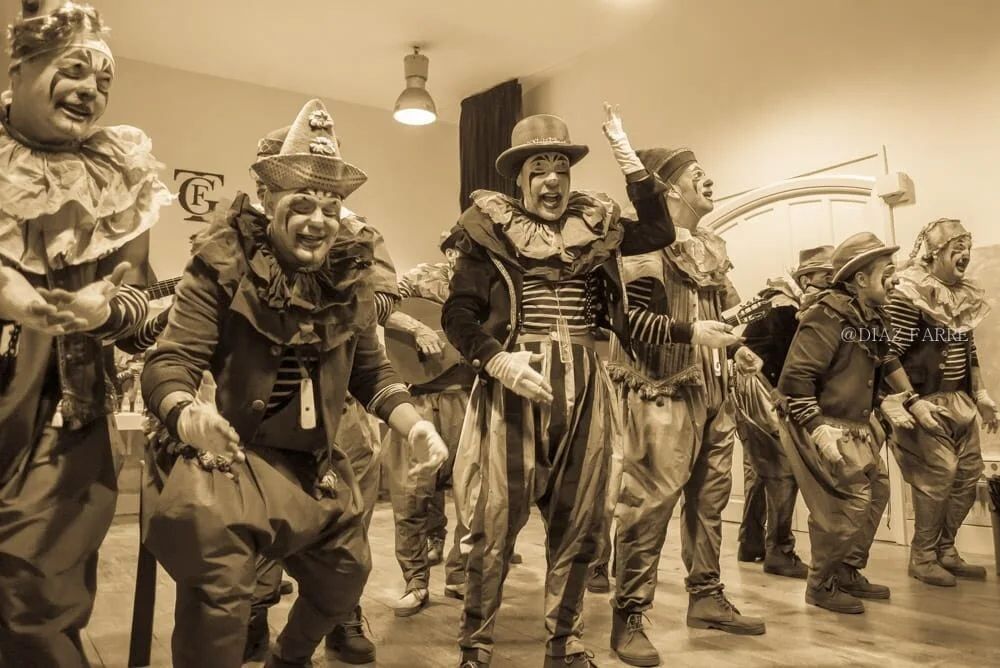
First quatrain: May, much more than a change of date
The bass drum gives way to the snare, the cymbals in the form of a tinkle, the guitars prepare the arrival of the punteao, a sound closer to the Cuban Alameda than to the Cádiz one introduces us to the first quatrain. The fingers of the front row follow the gentle rhythm, to then list first, and question afterwards, the month of May.
May is mentioned not as a simple month but as the date to which carnival was moved during the dictatorship (Mayo / Hemos vuelto al mes de mayo). It begins with a list of the events around these dates, such as the Rocío, the May crosses, Corpus (La custodia de Cristo), the fair and the remembrance of the uprising in Madrid in 1808 (Y en el aire / Aquel dos / De mayo).
Mayo
Hemos vuelto al mes de mayo
El de las romerías
De las cruces, los caballos
La custodia de Cristo
El pasado bajo palio
De Feria, vino, bailes
Y en el aire
Aquel dos
De mayo
The list goes on, more moments than events, to end with the ironic reference to the heat (La calle del infierno) and to getting bikini-ready, perhaps? ;D (Esos ojos/Esos cuerpos/De las pavas/Y los gallos)
Mayo de moritos y cristianos
Los trucos y los tratos
El castigo del solano
La muerte pinta cuernos
Y la vida crea patios
La calle del infierno
Esos ojos
Esos cuerpos
De las pavas
Y los gallos
From here the criticism begins, starting with the world of the coro and the authors' association. How? Well, by digging a little, it turns out that under the name Guacamayos y Lechuguinos appears a famous coro from 1984 with music by Julio Pardo (a leading figure in the world of the coro) and lyrics by Quico Zamora (president of the Cádiz Carnival Authors' Association – aaccadiz.com). It is also possible that they are referring to the historical figures that coro represented, in which they are urged not to stay quiet, not to be submissive.
The name of the coro takes us back to a curious historical moment during the War of Independence:
“In Cádiz four battalions of Distinguished Volunteers were formed selflessly, at the expense of the most prominent social sectors of the city. The vivid colour of their dress… …Because of these colours, they were soon known by the name or nickname of ‘guacamayos’. Facing them, the ‘lechuguinos’ also stand out, who were the Volunteers of Extramuros, so called because of their farming work in the market gardens of the area.
GUACAMAYOS Y LECHUGUINOS (lavozdigital.es)
¿Que dónde están los lechuguinos?
¿Y dónde, donde
Mis guacamayos?
Callaos están
Callaos
Callaos están
We continue with the end of the quatrain, which reveals itself through sadness, unease and helplessness (Y que hago ahora con esta furia /Con este nervio/Con estas ganas… …/yo lloro/que no) at the change of date, constantly playing with the analogy to the tipo (De fiestas típicas gaditanas) versus the protest at the changes to the 2022 carnival.
Y qué hago ahora con esta furia
Con este nervio
Con estas ganas
Quién nos diría que te vería
De fiestas típicas gaditanas
Cómo me trago esa mascarada
lloro, lloro
Yo lloro
Que no
The reason for that rebelliousness is justified with elements that are not part of local identity (Qué yo no soy de caseta y olé) and ones that are part of Cádiz identity, such as the Caleta, the wintry night of the Mentidero, the beach (Que yo soy niño de arena y cantil). He rounds it off again with the idea of not being submissive in the face of the change of date. For the author it is not an aesthetic question; throughout the repertoire he laments how that shift of carnival to spring underlies the distortion of carnival by those in power, as was done at the beginning and in the middle of the 20th century (Mayo/ Hemos vuelto al mes de mayo / Que no)
Que yo no soy de caseta y ole
Que yo soy más de Caleta, cuplé
Y luna en el mentidero
Que no
Que yo soy niño de arena y cantil
De María Hierbabuena
Cami
Caminito al matadero
Mayo
Hemos vuelto al mes de mayo
Que no
Second quatrain: hard times
In the classic Yuyu style (stylistically speaking, of course) a proper name is used to build the message. This has two interpretations, both complementary: the first is purely and simply that it makes the rhyme fit well, and the second is that, through personification (Mariví, Sebastián, José Luis y Maribel do not exist, they are literary devices) the audience empathises more and the message about today's problems (water, electricity, energy, the war in Ukraine, housing…) lands better.
Mariví
Que la hambre la vamos a sentir
Sebastián
Sube el agua, la luz sube el gas
José Luis
Catastrófic cuidao con Putin
Maribel
Alquiler, el autónomo, impuestos
Imposible el ingreso
Y estamos a día tres
A dig at the emeritus king, for fleecing the taxes behind our future pensions and for all his opaque wealth. For those outside Spain, there is an expression, “tener o ser una cara dura” (literally, to have or be a hard face), that is, to be shameless; that is why the author says (De titanio la tiene en verdad) that his face is harder than titanium.
Y si llego a la jubilación
Lo mismito no me queda na
Pues mi rey el pedazo Borbón
De titanio la tiene en verdad
He laments people's inaction in the face of the rise in petrol prices, the government's outbursts and the “domestication” of people in the face of so much inequality. He questions himself (Digo yo o estoy loco perdío), and asks once more why that apathy (El país debería de arder)
A callar y acatar
Gasolina como nos dominan
Con la manguerita da un poquito mas
Y anteayer a una ministra decir
Lo peor está aún por llegar
O la gente está domesticada
O esta tonta, no entiendo, no se
Si después de lo que hemos vivió
Digo yo o estoy loco perdio
El país debería de arder
Followed by a very well-placed comic finish. For those of you who don't understand the (A la calle cofrades), it refers to this audio: Cofrades a la Calle!! – YouTube. It went viral on WhatsApp during the pandemic, in which, ‘apparently’, a capillita urges people to break the lockdown and isolation rules in the face of covid. We will never know whether the person who spread this audio was being ironic or serious; what is certain is that nobody took it seriously and it went so viral that this COAC has referred to it a lot.
A la calle cofrades
Jajaja
After a moment's breather with the cofrades, he puts the focus back on the government and, in general, on politicians as the heart of the problem. He stresses that it makes no sense for us to argue among ourselves. The responsibility, the solution according to the quatrain, has to come from them.
A very topical detail (El problema de ahora es la carne / No las macro granjas que llena el congreso). Not long ago in Spain there was a controversy, when a minister hinted at regulating the macro-farm industry.
El problema de ahora es la carne
No las macro granjas que llena el congreso
El problema no somos nosotros
nosotros, vosotros
El problema son ellos
Son ellos, son ellos
Before closing this second quatrain, he goes back to the first structure of proper names. He highlights carnival as the remedy for so much unease (Por lo menos tengo carnaval) and warns about the far right (Adolfito esta ya al caer). Adolfito is Hitler, and today's Spanish Hitler is not a person but a movement very close to those ideas, disguised in green and wrapped in red-and-yellow flag-waving jingoism.
Caridad
Por lo menos tengo carnaval
Juan Miguel
Adolfito esta ya al caer
Mariví
Que el hambre, el hambre
La hambre
La vamos, la vamos a sentir
Third quatrain: mask
The halfway point of the popurrí rests on this timeless proposal, with a very hackneyed concept such as the mask, but in the hands of Antonio as poet and musician he reinvents it, transforms it, beautifies it, revolutionises it.
The first stanza is sung, almost recited, with the voice bare, without artifice. The guitar only lets a timid note peep out at the end of each line. What matters is the poetic message, deliberately ambiguous.
(Máscara / te vas como viniste / A este mundo con tu máscara) you don't know who or what it is addressed to, but it is clear that it is no longer here, although it was always wrapped in a mask. What does the mask mean? Don't worry, we will unpick it little by little. It left us, but with the first memory (Con tu primer recuerdo). Perhaps someone in particular, perhaps the Spain of the 20th century with the civil war (De un soldado y una máscara) and its two periods (República y corona) as questioned democracies (Años grises con sus máscaras).
Máscara
te vas como viniste
A este mundo con tu máscara
Con tu primer recuerdo
De un soldado y una máscara
República y corona
Años grises con sus máscaras
During the second stanza, the guitar begins to harmonise and dress the scene, with a timid crescendo. Meanwhile Fali Figuier sharpens the last line with his mask dance.
The First World War (Máscara / La guerra la primera) with the start of the working-class revolution (Barrio pobre hecho de máscara / Revolución obrera) owing to the material and political conditions after the war in Europe. They had to carry on despite the hunger (Sin trabajo solo máscara / No hay nada que comer) but luckily love arrived, between equals who are joined only by the mask (Llego el amor / Baile de máscara)
Máscara
La guerra la primera
Barrio pobre hecho de máscara
Revolución obrera
Sin trabajo solo máscara
No hay nada que comer
Llego el amor
Baile de máscara
The snare and the bass drum begin, for the first time, to set the pace for the precise, vaporous, indispensable coreao. The group stops singing inwards, they are longing to mark every line, the guitar melts into the voices, especially that of Javier Ramirez. The strength of the group begins to be unleashed.
We speed through the 20th century, passing through the Spanish Civil War and the emigration that followed it to the north of Europe (Máscara / España se desangra / Pa Alemania y una máscara). The Second World War (Segunda gran guerra), the morality imposed by the dictatorship (El sexo / dios / Familia máscara), the historic advances (Llegamos a la luna), the supposed welfare state of the 80s and 90s (Tu casita / Y una vida de hipotecas y de máscaras)
Máscara
España se desangra
Pa Alemania y una máscara
Segunda gran guerra
El sexo, dios
Familia máscara
Llegamos a la luna
Tu casita
Y una vida de hipotecas y de máscaras
The group has become one, the strength of the whole catches you and, without even remembering how it happened, your body sways unconsciously, rocking from side to side to the rhythm of each line.
Here everything becomes more cryptic. (Máscara / Tu hijo y tu mujer / Y cada uno con su máscara) Is he speaking to a man with a family? When your life seems stable, the wife leaves (death? divorce?) and the mask you have lived behind all your life falls (Por fin el bienestar / Adiós mama / Cayó tu máscara). When? At the start of the 21st century everything is revealed just as it really was (El nuevo siglo abrió la negra caja de las máscaras)
Máscara
Tu hijo y tu mujer
Y cada uno con su máscara
Por fin el bienestar
Adiós mama
Cayó tu máscara
El nuevo siglo abrió la negra caja de las máscaras
We go back to the simple note of the first stanza at the end of each line. The group sings inwards, with a tone of sadness and resignation in their performance.
The main speaker says goodbye to that man (Máscara / Cuando te despedí), someone who even in his last moments was still wearing that mask (Llevabas puesta una máscara). After listening many times, to me it still sounds as if it says (Y a mí me conocías) instead of “ya no me conocías” (Enredao en muchas máscaras), you be the judges.
The conclusion is clearer in its concept: those who die, those who go to heaven (No hay nubes en el cielo) are the ones who really purge those masks, they are free after a whole life beneath them (Simplemente son ellos al fin libres / De sus máscaras)
Máscara
Cuando te despedí
Llevabas puesta una máscara
Y a mí me conocías
Enredao en muchas máscaras
No hay nubes en el cielo
Simplemente son ellos al fin libres
De sus máscaras
The ending finishes in a crescendo in three voices, with that Cádiz tug at the heartstrings. If this quatrain doesn't move you, you are not human.
Máscaras
Máscaras
Máscaras
All this is very well, but what do the masks mean?
We go through life trying to find out what moves us, we believe we are free and in fact we are much more so as children. But time, ourselves and our context drive us to take refuge, more or less deliberately, in our masks: social norms, our surroundings, the inertia of the course of our lives… The tools with which we face the world always require, in the end, a layer of protection, a psychological coat with which to be able to cope with the world.
Often, from today's liberal postmodernism, it seems that the only thing that exists is the individual, the mask as a balm for the other, for others, even for those we love (Llego el amor / Baile de máscara), freedom only exists if it meets my individual needs.
Antonio does not delve into the other side of the coin: can one only be free without a mask? I think we have to know ourselves very well, to know how to tell when we wear the mask and when we don't. I go further, the mask can be adaptive, just like emotions. Can you imagine someone always, always showing forced joy? Can you imagine a person who has never, ever experienced sadness or fear? A person who is always angry? That person is not really healthy.
The mask understood as a betrayal of your identity is neither adaptive nor healthy. But the mask as a tool for coping with the world is inevitable and necessary. As Jorge Drexler said: “Life is more complex than it seems”
Fourth quatrain: carnival now and then
We change register completely. The music once again recalls the sister continent; the quatrain delves into criticism laced with humour, setting against each other the two ways of understanding carnival, then and now.
Right at the start, the second voices proclaim the difference between today's carnival and that of the past: prisoners for singing (Cautivos de las coplas) versus an amalgam of coplas (Rebaño de los cantes) and he introduces what will be the explanation of that duality (Es el mismo estribillo / Ahora que antes), it only lacks the grammatical colon, replaced by a “ye yuré yureeee!, yu yu ya yaaá!” (or something like that ;D ).
Cautivos de las coplas
Rebaño de los cantes
Es el mismo estribillo
Ahora que antes
In the background the choruses carry on with their lively, cheerful “ye yuré…”. A little pill of history (El concurso se creó / Para someter al pueblo) the origin of the COAC goes back to the early 20th century as the response of those in power to the people's unstoppable urge for carnival. They do not do it out of love for the festival, but to keep it under control (¿Tenemos libertad? / Nadie saca el pie del tiesto). He stresses how the dictatorship used ordinary people to spread its propaganda (Analfabeto animando / Los años dictadores) and, almost without blinking, a swipe at today's Holy Week (Con el COAC pagamos a los cofrades subvenciones)
El concurso se creó
Para someter al pueblo
¿Tenemos libertad?
Nadie saca el pie del tiesto
Analfabeto animando
Los años dictadores
Con el COAC pagamos a los cofrades subvenciones
Before, the serious thing was how they censored the coplas, overcome only with the skill of always using double meanings in the coplas (Censura / y el monstruo de doble sentido). Now (La tele, YouTube, /un solo camino) the media are the great censorship.
Censura
y el monstruo de doble sentido
La tele, YouTube,
un solo camino
Before, the hardships on the faces of the copleros and a piece of charcoal as improvised make-up (Fatiguitas en la cara / Carboncillo y mucho es). Now, direct criticism of the shady dealings in the resale of COAC tickets, even by the jury (El jurado vende entradas / Que no llega a fin de mes). But it is better to keep quiet and carry on singing, looking the other way (Tu canta payaso / Mande quien mande)
Fatiguitas en la cara
Carboncillo y mucho es
El jurado vende entradas
Que no llega a fin de mes
Tu canta payaso
Mande quien mande
Before, the criticism stayed local (Antes /Cuatro fantasmas reventando las finales); now social media have cannibalised the COAC and have turned into know-it-alls in the pure style of a TV political talk show (Ahora el odio concentrado en redes sociales / Un público filósofo y tirano / Que sabe hasta italiano / De música ni hablamos)
Antes
Cuatro fantasmas reventando las finales
Ahora el odio concentrado en redes sociales
Un público filósofo y tirano
Que sabe hasta italiano
De música ni hablamos
Before, you could be shot for what you sang (Antes / Al paredón a fusilar carnavaleros) and now people are more afraid of the jury's verdict (Ahora en la ciudad de Cádiz que miedo)
Antes
Al paredón a fusilar carnavaleros
Ahora en la ciudad de Cádiz que miedo
We finish with the conclusion that, in spite of everything said above, carnival goes on as always, and so do the forces that rule over it. They have changed little over the years (Está visto y comprobao / que ahora y antes / El collar no ha cambiado).
By way of a link, he prepares us for the next quatrain (Y antes te quiero contar / Una cosita picante / Que te va a gustar)
Está visto y comprobao
que ahora y antes
El collar no ha cambiado
Que se acaba el popurrí
Y antes te quiero contar
Una cosita picante
Que te va a gustar
Fifth quatrain: sensual cha cha cha
The sensual cha cha cha, that is how I like to call the first rip-roaring quatrain in history dedicated to the streets of Cádiz. Another stroke of genius from Don Antonio.
I will not dissect the lyrics step by step this time, since it all works as a harmonious whole that manages, with top marks, to be sensual and carnal. The mere feat of fitting words like (cuarto oscuro, flujo, humedad, empalmar, penetrarte, galopar, soy tu perrito, tu fiel esclavo…) into one quatrain without it coming across as coarse or vulgar is stunning.
Carnal
Sexual
Cha, cha, cha
Como me gusta ir al cuarto oscuro
De la Caleta en la bajamar
Acuclillado desalar tu flujo
Y palpar la humedad
Semidesnuda empalmar tus barrios
Si, penetrarte al norte o bien al sur
Y recorrerme calles
Plazas, patios
Explotando de luz
Ella es la dama inmortal
La pagana hija de dios
Tú, mirar, puedes mirar
Pero solo toco yo
Átame en corto
Te sigo a oscuras
Como galopa mi sangre
Noto muy cerca tus dunas
Soy tu perrito
Tu fiel esclavo
Soy lo que quieras
Lo que quieras
Calla, calla, callo
Once again, as a link, following the narrative of the character, he uses another three lines that prepare us for the last quatrain.
Están llamando a los grises
Señores con dignidad
Aún nos queda la última ración de libertad
Last quatrain: the goodbye
The celebrated, festive, danceable last quatrain sounds like transatlantic carnival, perhaps like Brazil in the cadence of the snare, with the coreaos present throughout, always harmonising, as well as its carnival stamp defined by the use (not sensual ;D ) of the whistle.
A classic farewell to the tipo, although if you look closely he says goodbye to the authorities, not to the audience, he never steps out of character.
Adiós
Me imagino que volveré a la prevención
Con esposas y cardenales
Por favor
Pero gracias por esta noche
Padre, alcalde
A sus pies gobernador
Here the metacarnival is very present, since the “ciudad invisible” is the name of the comparsa he had planned for the February 2022 carnival. For all of you who hadn't noticed, Don Antonio gives you a huge spoiler about his future in the coming carnivals of February 2023.
Ya me voy, pero quede claro volveré
Por febrero con menos miedo que esta vez
Vuelvo a la ciudad invisible
Esa que me vio nacer
The character mocks the authorities and decides to change the sacred lyrics of the Spanish anthem a couple of times (Viva España / Que rima con migraña / Rebaña, guadaña, calaña…) (Viva España / Que rima con cizaña / Patraña, engaña y extraña), running rings around the police and knowing that, whatever he says, he will once again be bound for prison.
Total
Como tampoco tengo na que demostrar
He dejado lo mejor, mejor para el final
Con permiso he cambiado la letra
En honor al carnaval
Viva España
Que rima con migraña
Rebaña, guadaña, calaña
Adiós
Imagino que volveré a la prevención
Con esposas y cardenales
Por favor
Pero gracias por esta noche
Padre, alcalde
A sus pies gobernador
Viva España
Que rima con cizaña
Patraña, engaña y extraña
Se nota como disfrutan de este colorido final, interpretando todo el tiempo, personificando esa cuadrilla de gaditanos que osaron cantar canciones prohibidas, a los que pagaron con esposas y cardenales.
Adiós
Me imagino que volveré a la prevención
Con esposas y cardenales
Por favor
Ya estoy yo en la ciudad invisible
invisible
adiós
adiós
To be clear: everything in this article is pure and simple interpretation or exégesis de patinillo (a term coined by the teacher born in La Línea, nursed on the beaches of Chiclana and street-and-illegal carnival-loving son of our beloved Cádiz)
Extras
Keep reading
Analysis of the popurrí of La Oveja Negra
I'm back once again with a literary analysis with philosophical overtones (the music I leave to the musicians), written from the subjectivity of someone who is trying to offer a view of the text and subtext without fanaticism or academicism.
Analysis of the popurrí of La ciudad invisible
Analysis of Antonio Martínez Ares's popurrí this year, 2023, with his comparsa «La ciudad invisible», focusing on the performance, musically splendid and full of comparsa details from the 1990s.

Cádiz Carnival: an analysis of the popurrí by Los Renacidos
It speaks directly to the listener, putting the focus on the nature of life, where the only permanent thing is change, a perpetual cycle.